Mathematics
The Mathematics department builds confident and joyful problem-solvers through hands-on learning, structured reasoning approaches, and enrichment programmes for students of all abilities.
Vision
To develop resilient and reflective problem-solvers who can apply Mathematics confidently in everyday life.
Mission
To provide authentic and rigorous Mathematics learning experiences that develop students’ ability to discover, reason and communicate mathematics with confidence.
Department’s highlights/framework
The Maths Department aims to nurture confident learners with a strong foundation in Mathematics. We design learning experiences that build essential numeracy skills, logical reasoning and problem-solving abilities that empower students to thrive in school, navigate real-world challenges and embrace future opportunities.
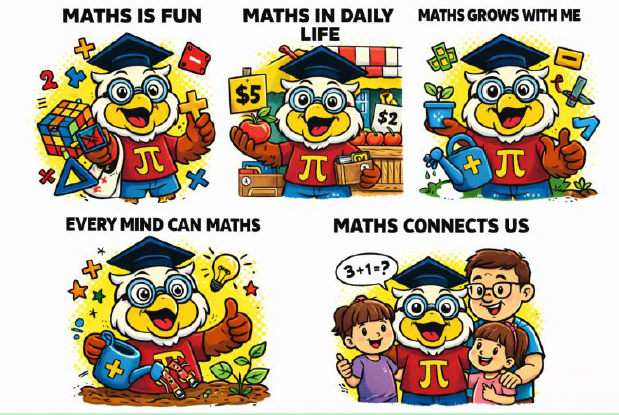
Our Maths Eagle Mascot is a natural extension of our school mascots- Connor and Caylee. Inspired by the same spirit of strength, curiosity and excellence, our Maths Eagle represents how Concordians approach Mathematics- with confidence, resilience and a love for learning. It carries forward the same core values while highlighting our five focus areas in Mathematics: Maths is Fun, Maths in Daily Life, Maths Grows With Me, Every Mind Can Maths, and Maths Connects Us.
Key Programmes
Fostering Joy of Learning through Learning Experiences
Opportunities are created for our students to explore, experience and discover Mathematics through daily lessons and school-wide Maths programmes. The use of manipulatives, ICT tools, and Maths Talks enhances students’ learning experiences and helps to instill the joy of learning. Beyond supporting students in understanding concepts and acquiring Mathematical skills, the learning experiences are designed to help them apply mathematics to real-life situations, think flexibly and use creative approaches to solve problems. These experiences are aligned to our five key aspects of Mathematics learning:
Maths Grows With Me: Students develop confidence and resilience as they learn, practise and strengthen their mathematical thinking.
Maths in Daily Life: Activities to help students see how mathematics is used around them, making learning relevant and meaningful.
Every Mind Can Maths: Learning experiences are designed to support and stretch students of all abilities, reinforcing the belief that every child can learn and succeed in mathematics.
Maths Connects Us: Collaborative tasks and Math Talks that help students communicate, reason and learn with their peers, strengthening connection and teamwork.
Maths is Fun: Engaging games, hands-on activities and playful challenges that build enjoyment and positive attitudes towards mathematics.
Overall, our approach ensures that every child experiences mathematics as a subject that is meaningful, connected and joyful.
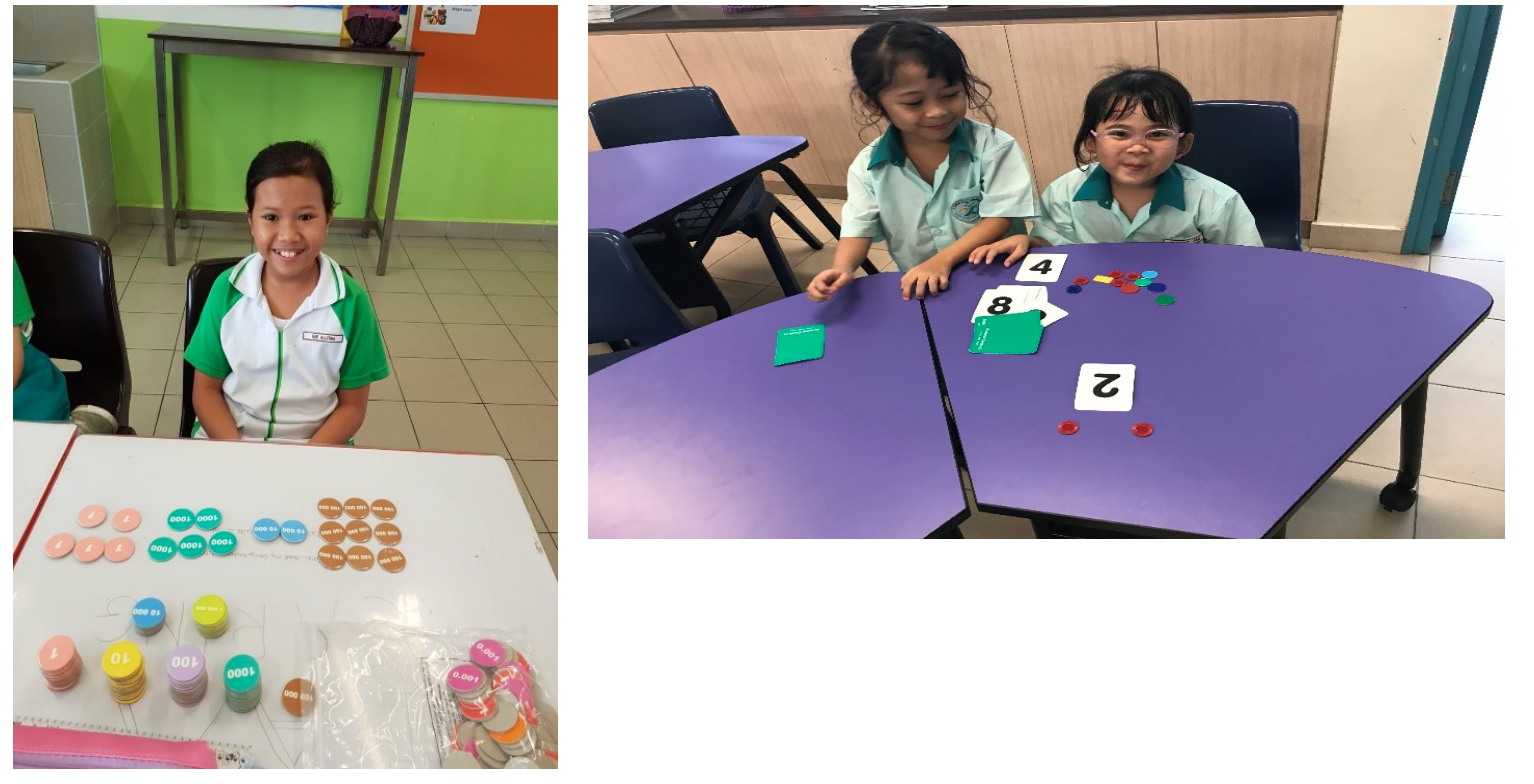
Use of manipulative in the lessons (P1 to 6)
In our lessons, students from Primary 1 to 6 use manipulatives such as counters, cubes and fraction disc. To grasp a good understanding of ideas before moving on to diagrams and numbers.
We use the Concrete–Pictorial–Abstract (C.P.A.) approach:
Concrete: Students start by using real objects they can touch and move.
Pictorial: They then draw or use diagrams (e.g., bar models, number bonds) to show their thinkin
Abstract: Finally, they use numbers, operations and symbols to solve problems.
This approach helps students understand concepts more clearly, build confidence and reduce misconceptions, laying a strong foundation for learning Mathematics.
Math Playground (P1 and P2)
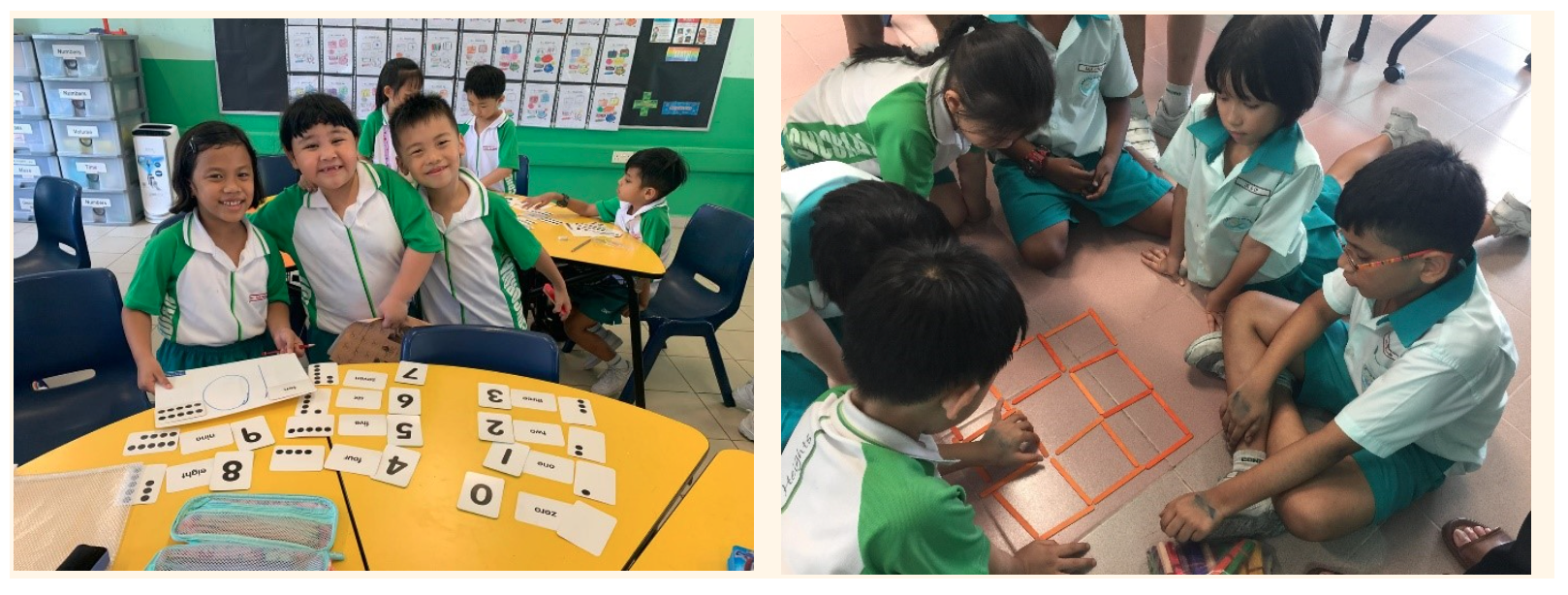
Math Playground in Concord allows our students to have fun doing Mathematical activities. Apart from the hands-on activities, the corner provides a platform for them to solve nonroutine problems through puzzles and games. The corner is open for Primary 1 to 2 students during their recess breaks and students get an opportunity to participate in challenging games such as Sudoku, Chess and Math Puzzles during their recesses. Students may also practise mastering their number facts through the online games accessible via tablets at the corner.
Maths Playground
The Maths Playground is a dedicated space in school where students can experience the joy of mathematics through hands-on games, puzzles and collaborative play. Students explore and enjoy Mathematics learning through purposeful play that strengthens:
Logical thinking
Spatial awareness
Reasoning and problem-solving
Communication and teamwork
Through games such as Jenga, Save the Penguin, Connect Four logic puzzles and number challenges, students learn to think flexibly, try different strategies, be resilient and support one another- skills that are essential in mathematics.
The Maths Playground also reinforces our school values, where students learn to:
Respect the equipment and one another
Take responsibility for keeping the area neat and safe
Care for their peers by playing fairly and encouraging one another
Overall, the Maths Playground makes mathematics come alive for students and helps students build positive attitudes towards mathematics, turning learning into an experience that is fun and meaningful.
Maths Trails Maths Trails (Primary 1 and 2)
Developing Metacognition and Problem-Solving skills (Primary 1 to 6)
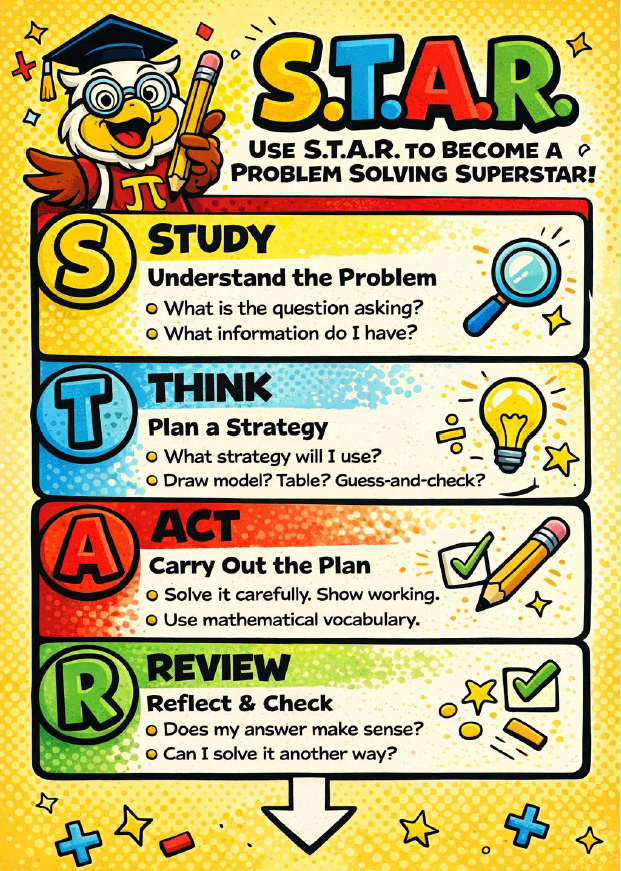
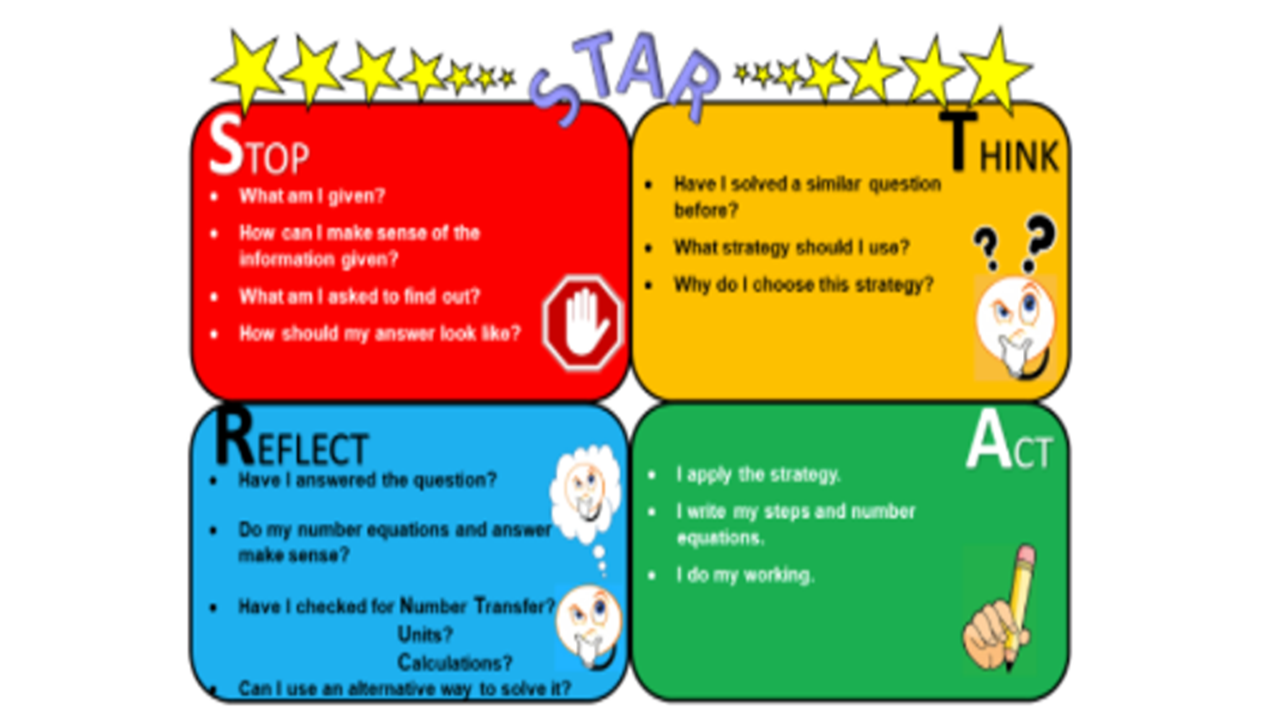
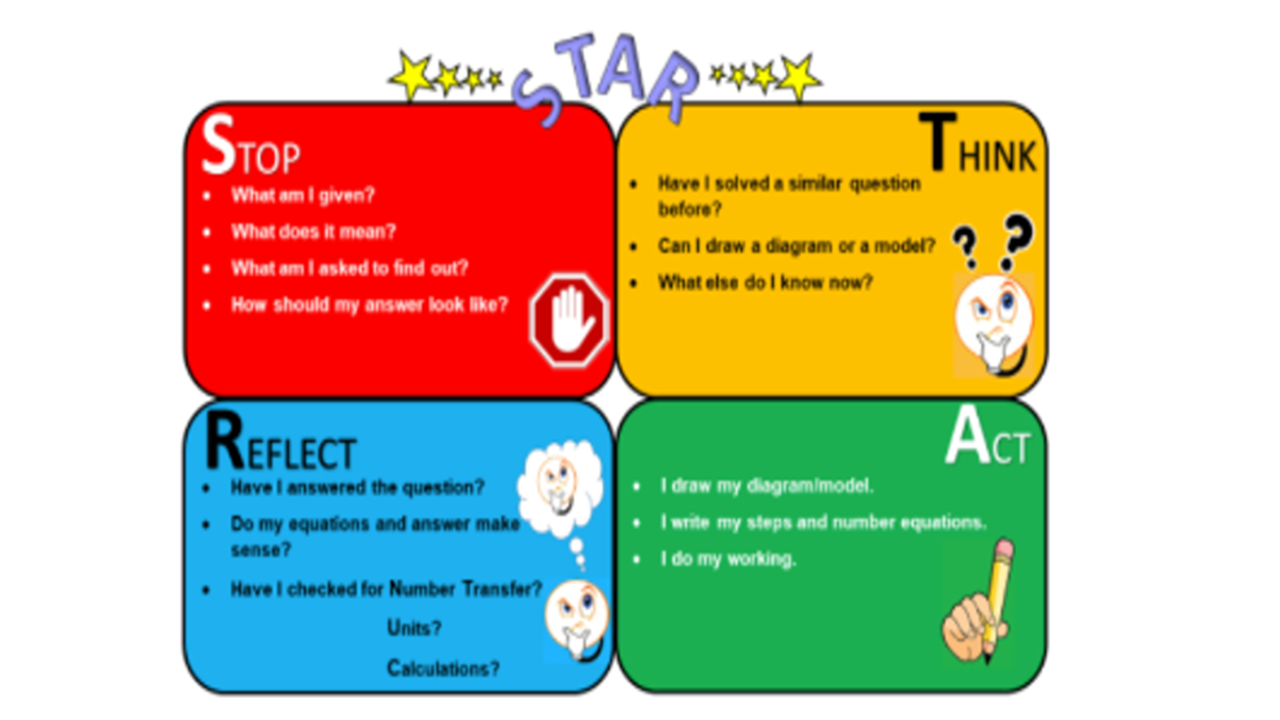
S.T.A.R. approach was adopted from George Polya’s four-step process for problem solving. It was created to help our students to scaffold their thinking when they tackle heuristics and problem sums via the questions at each step of the approach. When students solve problems, they will make use of the 4 steps - Study, Think, Act, Review. Throughout these four steps, metacognition plays an essential role in problem-solving as students make and regulate their thinking and their decisions. The S.T.A.R. approach was customised into two versions. One for the Primary 1 and 2 students and the other for Primary 3 to 6 students.
Developing Metacognition and Problem-Solving skills (Primary 1 to 6)
S.T.A.R. approach was adopted from George Polya’s four-step process for problem solving. It was created to help our students to scaffold their thinking when they tackle heuristics and problem sums via the questions at each step of the approach. When students solve problems, they will make use of the 4 steps – Study, Think, Act, Review. Throughout these four steps, metacognition plays an essential role in problem-solving as students make and regulate their thinking and their decisions. The S.T.A.R. approach was customised into two versions. One for the Primary 1 and 2 students and the other for Primary 3 to 6 students.